

Life, Language, Learning and Laughter – English language conversation groups
The Challenge and Gift of Language
People who have learned English from birth hardly know they’re using language at all. But when you’re an adult and your first language is, say, Chinese or Spanish, English is an ocean you might drown in. You struggle to breathe and to speak at the same time.
English-speakers have the same reaction when they start classes in, for instance, Korean. Expressing yourself well in an additional language is no easy thing. It’s a series of steps, with many stumbles.
The issue of ‘having a voice’ is one of justice in the Hebrew Scriptures of the Bible - “Speak out for those who cannot speak, for the rights of all the destitute. Speak out, judge righteously, defend the rights of the poor and needy.” (Proverbs 31:8–9)
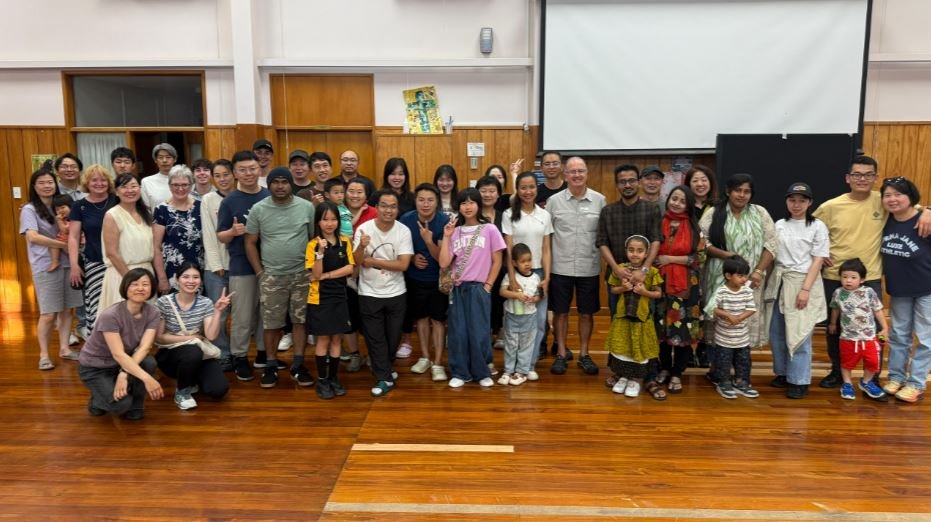
A Place to Find Your Voice
At Chartwell Cooperating Church in Kirikiriroa, Hamilton, each Tuesday night during school terms, 40 to 50 people from at least 12 different countries gather at 7pm for English conversation groups. The organiser is the Rev. Daniel Park, and the groups are a ministry of the Church.
The aim of the evenings is to allow people who have English as an additional language to find their voice — to converse in English, to practise, to listen and to form friendships.
Evenings begin with informal chatting and then everyone sits in a large circle. There’s an icebreaker activity — fun, and a way to mix and meet. Newcomers are introduced and warmly welcomed. Then we move into smaller groups around 7.20pm.
In the groups, people respond to gentle questions on a particular topic. The topic and questions are sent to tutors via a WhatsApp group in advance, and a successful evening requires careful preparation.
Example Topic: Living a Meaningful and Happy Life
What makes your life feel meaningful right now?
What is one small thing that makes you happy these days?
Who inspires you to live a better life, and why?
What is one habit that helps you stay positive?
What is something you want to improve in your life?
When do you feel the most thankful in your daily life?
What is one dream or goal that gives you hope for the future?
Learning Through Conversation and Community
There’s no diagnostic entrance test, but after a conversation with Daniel, people are placed in a group that corresponds to their English language competence. There are usually six groups, each with a local tutor or leader.
The tutor’s role is to gently elicit responses, guide the conversation when needed, and ensure that everyone has an equal opportunity to speak. I’ve had the privilege of facilitating a group of people who are already fairly fluent.
These conversations are exercises in communication, including listening. Good listeners create an environment in which people feel ready to speak. People need to know they won’t be ridiculed or criticised. As trust builds, participants begin to feel a kind of joy in taking part.
Those of us with English as a first language also have something to learn — to listen with compassion, patience, and a commitment to justice for those without this linguistic advantage.
A Welcoming Space of Faith and Belonging
The Christian church is a linguistic community — shaped by scripture, prayer, conversation and shared words — yet it is also a place of togetherness and silence, even before a word is spoken.
When people come to the Chartwell Church language groups, they know they’re entering a Christian space. There is little explicit Christian language, though a prayer opens and closes the evening. Many participants are familiar with Christian traditions, while others come from different faiths — all are warmly welcomed.
The welcome begins even before words: in smiles, gestures, and chairs set out ready for everyone. There is also a group for those who wish to explore the Christian faith more deeply.
In these conversation groups, everyone gains — tutors and participants alike. Participants grow in confidence and fluency, and it’s a joy to meet them out in the community and hear how they are doing. Families often share childcare so both parents can take part.
“Enabling people to find their voice and to express themselves in English in this new culture and society; it’s a way of doing justice and expressing kindness.”